Showing posts with label crohns disease. Show all posts

Sunday, December 7, 2014

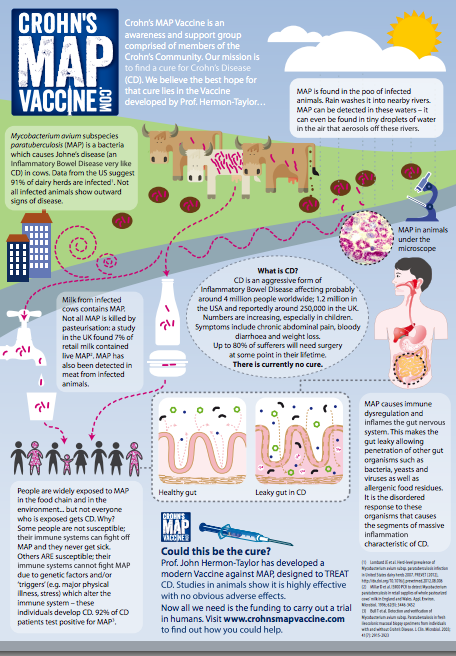
Infographic Snapshot of the Lifecycle of #MAP in People w/ #Crohns

Great infographic image of the life cycle of MAP.  


The part of this picture that should jump out at you is the statistic on the bottom left. citation # 3

92% !!!....... this is madness!  This isn't new news people.  So why doesn't anyone know about MAP and it's relation to Crohn's?  I'm not talking about lay persons, but people in the profession of helping people get better who are living with this disease.  They don't acknowledge it.  The medical community flat out ignores the science and the 30 years or more of research that exists.   People need to take charge of their life and health and start fighting to know something.  Ask questions and demand an answer is where I'd start.  


Click link below to view image larger from original source:

Thursday, February 6, 2014

Is It Possible to Cure Crohn's Disease? I Think So

A writer for Psychology Today, contributes the following article (and 2 more that I will post after this article) pertaining to something that I have read up on and firmly believe is the culprit to Crohn's disease.  Everyone should read this information and remember it.  I think a lot of people have been made hopeless or skeptical in regards to Crohn's disease because people are told so many things that contradict that there will ever be a cure.  Doctor's have been telling people for decades now that there will never be a cure.
It's a new day people, get out of the rut of thinking in the past and open your mind to new developements and discoveries.  It's worth it and I am super duper hopeful.


Through luck, hard work, good fortune, perseverance, and wonderful doctors, I seem to be one of the few people in the world who can claim to be “cured” of Crohn’s Disease. I’ve told this story before, in several places, but I feel a need to get the information out to a more general audience, even though this is not a psychology story but a medical and scientific one. In September, 2005, I wrote a small article for the PCC SoundConsumer, a very small newspaper published by a local Seattle natural foods grocery store, about my experience with Crohn’s Disease. http://www.pccnaturalmarkets.com/sc/0509/sc0509-hw-crohns.htm For some reason, that little article went viral, and to this day I receive letters from people from all over the world asking for information about Crohn’s Disease and its probable connection with a specific microbe, mycobacterium avium subspecies paratuberculosis (MAP). I told the story again in a scientific journal, the Paratuberculosis Newsletter,http://www.paratuberculosis.info/web/images/newsletters/2012q2.pdfBut that journal is not highly visible. Since 8 years has gone by, and I have much more information now, I am going to put this on Psychology Today, for the benefit of all of those who suffer from Crohn’s or who love people who suffer from Crohn’s. I will have to tell this story in several segments, since Psych Today restricts individual posts to about 800 words. Please bear with me. I will be providing a lot of information, references, and information that is crucial to individual and public health.Single case reports are no longer the fashion in modern medicine. We all know that an n of 1 plus 1 plus 1 plus 1 ad infinitum equals nothing in terms of proving causality in “evidence based medicine”. Proving anything in the case of Crohn’s Disease is difficult. See this excellent review of this situation, Causality and gastrointestinal infections: Koch, Hill, and Crohn’s by Anne-Marie Lowe, Cedric P Yansouni, and Marcel A Behr, Lancet Infect Dis 2008:8: 720–26. You must understand that for scientists today, a single case report is virtually meaningless. However, my victory over Crohn’s Disease doesn’t prove anything by itself, but I think that it matters insofar as it suggests the desirability of pursuing a more detailed scientific inquiry. Furthermore, there are hundreds of thousands of people with Crohn’s, many of them children, who are being treated under a different paradigm, and with variable success. Moreover, I think many of those people got sick because they consumed contaminated food products without knowing it, sometimes years before the disease manifested itself. I think there is better way to treat Crohn’s, and better yet, to prevent it. In brief, I think I was “cured” of Crohn’s Disease with antibiotics directed at the eradication of Mycobacterium avium subspecies paratuberculosis.Background: MAP is a small bacteria in the same family as leprosy and tuberculosis. In 1894, two veterinarians, Dr. H.A. Johne and Dr. L. Frothingham, identified this organism in a cow with weight loss and poor milk production in Germany. It is an acid-fast bacterium, like TB and leprosy, but has other properties as well. The best place to read about MAP is on the web site www.johnes.org

Farmers rapidly learned that their cows could develop either bovine TB or what came to be known as Johne’s Disease. Both were serious and expensive for the farmers. However, for various reasons, everyone agreed that tuberculosis could be transmitted from cows to people, and many public health measures were put into place to stop bovine TB. However, to this day, the USDA and the IOE, the World Organization for Animal Health http://www.oie.int/ deny that MAP is a “zoonotic disease”, a disease that can be transmitted from animals to people. The ostensible reasons for this are that MAP cannot be visualized in human tissues with ordinary microscopes (while it is easy to see MAP in animal specimens); PCR studies and other DNA fingerprinting technologies yield ambiguous results; and nobody dares to try the experiment to prove Koch’s postulates, which would be to grow human MAP in culture, and then feed those germs to human infants. That would be immoral and ridiculous. For various reasons, scientists dispute the claim that MAP causes Crohn’s Disease because Koch’s postulates have not been fulfilled, even though nobody has ever grown M. Leprae (the germ that causes leprosy) in culture. It has to be grown in the foot pads of armadillos…. Koch’s postulates are not applied to viruses, prions, or other pathogens. Even though MAP comes very close to meeting Koch’s postulates, its pathogenicity is disputed. (There was even an experiment in the 1980s in which MAP was grown from human biopsy specimens, and then fed to baby goats. The goats got Johne’s Disease. But it was a small n…)
As a result, animals that test positive for MAP are not culled and eliminated from human food products. They can be sold for meat, into the food supply. Moreover, viable MAP can be cultured from milk, including pastuerized milk, around the world. MAP is a very stubborn bacteria, resistant to heat and chlorine. It thrives on biofilms, and has a persistent spore that can last for years. The incidence of Crohn’s Disease in the world has grown in proportion to the use of dairy products. For example, Japan had little Crohn’s 100 years ago, and now it is becoming a significant problem. When you go to the grocery store and consider buying raw milk products, remember that MAP is endemic to cows, sheep, and goats, and roughly 1% of pasteurized milk in the US contains viable MAP.

Wednesday, December 18, 2013

Identifying & Destroying the Cause of Crohn's Disease #ibd #MAP

Encouraging and hopeful article!  


'UCF College of Medicine professor Dr. Saleh Naser soon will participate in a clinical trial to test whether a new antibiotic therapy acquired by RedHill Biopharma can be used to treat Crohn’s disease patients.
The FDA-approved phase III trial is expected to commence within weeks by RedHill Biopharma, which licensed Naser’s DNA technology for detecting Mycobacterium avium subspecies paratuberculosis, known as MAP. It is believed to be associated with Crohn’s disease. RedHill Biopharma developed the anti-MAP antibiotic regimen known as RHB 104. Crohn’s disease is a chronic inflammatory disease of the gastrointestinal tract characterized by cramping and diarrhea.
Naser developed and patented a way to detect MAP from milk, blood and tissue clinical samples. The bacterium is known to cause inflammation in the intestines of cows. It is also linked to Crohn’s disease, although its role has been debated for more than a century. Naser believes MAP is an underlying cause of the disease.
“Crohn’s disease affects more than 750,000 Americans, yet traditional treatments only address the symptoms of inflammation and not the cause,” Naser said. “I have seen case studies where patients’ lives have been restored following treatment, which removes MAP. I have high hopes that this clinical trial may lead to finding a cure.”
RedHill will be enrolling 240 subjects from the United States, Canada and Israel in this double blind clinical trial in which blood and intestinal biopsy specimens from Crohn’s patients will be tested for MAP before, during and following the one-year treatment with the antibiotic RHB 104.
“Since we acquired the license to Dr. Saleh Naser’s MAP detection technique in 2011, we have had an excellent collaboration with UCF,” said RedHill’s CEO Dror Ben-Asher. “The UCF team of researchers… is at the forefront of global academic research on MAP and its detection.”
Naser is looking forward to the trial and hopes this will end the academic debate regarding MAP and Crohn’s disease.
“I am ecstatic to be part of a team, which will help determine whether or not MAP is associated with Crohn’s disease; certainly a final answer to a one hundred-year old controversy,” Naser said.
Naser joined UCF in 1995 and has been a faculty member in the medical college since its foundation. He teaches clinical chemistry and infectious processes in the Burnett School of Biomedical Sciences within the medical school. He also serves as the graduate coordinator for three masters programs in the College of Medicine.